



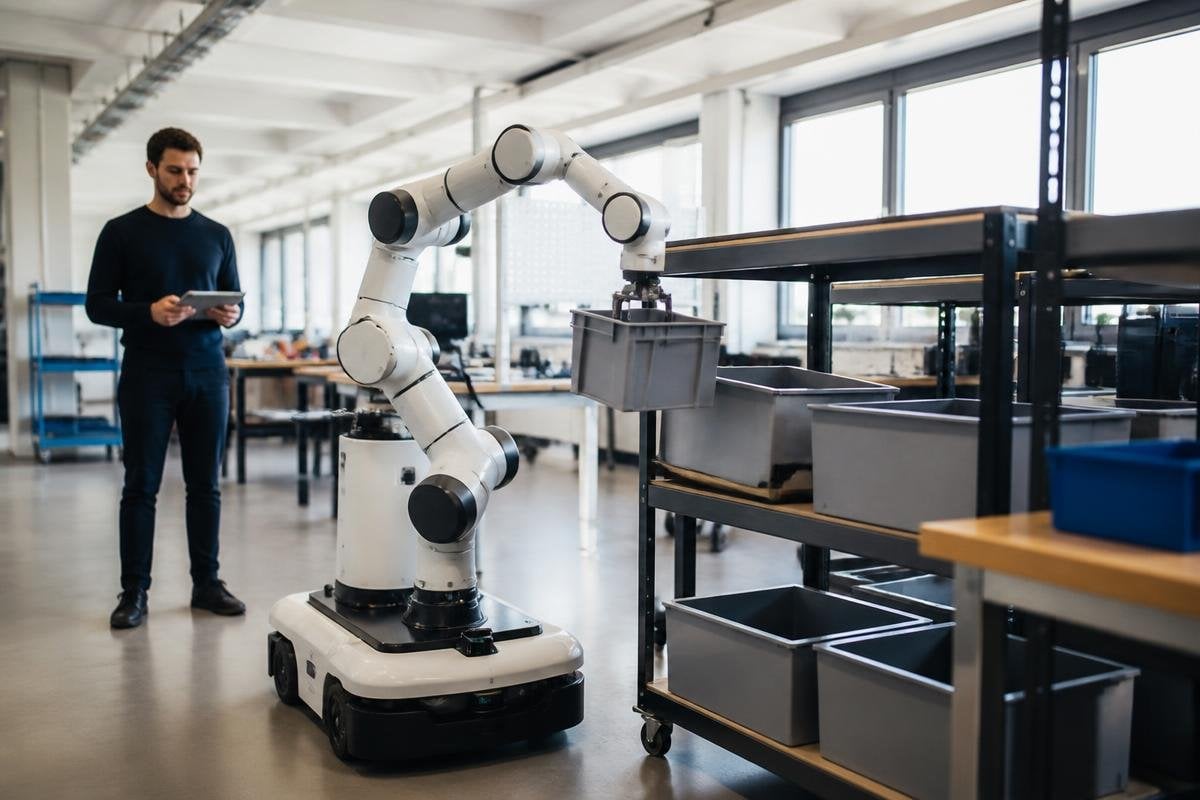
Robots will take on more work over the next ten years, but the biggest change may happen in software rather than motors or frames. The machines that earn a place in factories, hospitals, farms, and homes will need to work safely around people and recover when real spaces differ from their training data.
Quick read
- Robots will move from fixed tasks toward software that can handle several related jobs.
- Human oversight will remain part of many autonomous systems.
- Buyers will judge robots by uptime, service cost, and safety records.
Robots will need to handle more than one task
Many robots work well when their surroundings stay fixed. A factory arm can repeat the same movement thousands of times because the parts, tools, and work area are known in advance.
The next step is a robot that can adjust its grip, route, or speed when an object moves or a person enters the work area. That requires cameras, force sensors, maps, and software that can choose an action from changing information.
This does not mean one robot will do every job. A machine built to lift boxes may never make a useful kitchen assistant. The practical shift is narrower: one platform may handle several jobs in the same workplace, reducing the need for a separate machine for each task.
Autonomy will grow, but people will stay in the loop
Autonomous systems can make choices without a person directing each movement. They still need clear limits, safe stopping rules, and a way for a worker to take control when the system meets something unfamiliar.
That human link matters in places where a mistake can damage equipment or hurt someone. A warehouse robot may run on its own for routine trips, then ask for help when a blocked aisle, damaged package, or unclear label stops the planned task.
The quality of that handoff will matter as much as the robot’s normal speed. If a worker cannot see why the machine stopped, recovery takes longer and trust falls. Good systems will show the failed task, the sensor reading that caused the stop, and the action needed to continue.
Training data will become part of the machine
The machine needs more than motors and sensors. It also needs examples of how objects move, how people behave nearby, and what counts as a safe action.
Simulation can create many of those examples before a machine enters a real site. A digital test can run the same pick, drive, or walking task under different lighting, object positions, and floor conditions.
The robot still needs checks in the real world because a model cannot reproduce every cable, reflection, or loose item. This creates a new cost for buyers.
A robot may arrive with hardware ready to run, yet need weeks of site data before it handles local work well. Ask who owns that data, where it is stored, and how the system changes after an error.
A safety stop means little if nobody can show which sensor triggered it or who restarted the robot. Reports from Robot24 can place those details beside the machine and test setting before the next section looks at safety during daily work.
Safety will move from paperwork into daily operation
Safety cannot stop at a certificate or a line in a manual. It has to appear in the robot’s speed limits, force limits, warning lights, emergency stops, and software updates.
A robot that works near people may need to slow down around a worker, stop when a sensor loses sight of the area, or limit the force at its arm. Those choices reduce output in some cases. They also define whether the robot can share a workplace without a cage.
I expect buyers to ask for operating records, not only demo videos. A short clip can show that a robot completed a task once; it cannot show how often the task fails across a full shift.
A practical buying checklist
Use these questions before treating a robotics trend as a purchase plan:
- Name the task: can you state the job in one sentence and measure a good result?
- Check the setting: will lighting, floors, objects, and people change during work?
- Price the support: include installation, training, spare parts, software, and repair time.
- Test the handoff: watch what happens when the robot stops or meets an unknown object.
- Ask for records: request uptime, failed-task rates, and safety events from a live site.
- Set an exit point: decide what result ends the trial before the robot arrives.
The next decade will belong to robots that fit real work, not machines that merely perform well in a controlled demonstration. Before you buy into any trend, ask for the task, the operating limits, and the record of what happens when the system fails.
